Friday, April 15, 2011

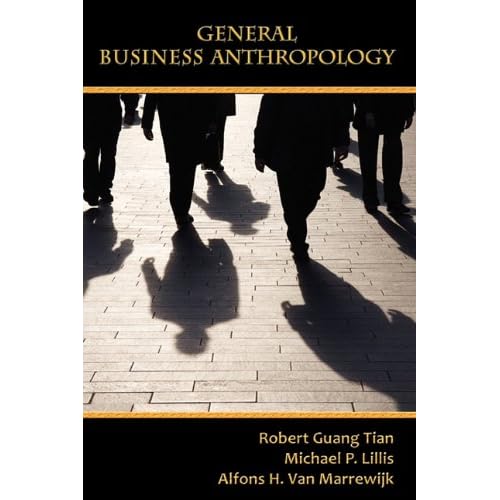
General Business Anthropology, A Book Review by Dr. Mahesh Ranjan Debata

General Business Anthropology
Robert Guang Tian, Michael P. Lillis, and Alfons van Marrewijk
Miami, FL
2010
pp.612 (Hardcover)
ISBN: 978-0-9828434-0-6
Key Words: Business Anthropology, Consumer Behavior, Ethnography, Organizational Culture, Product Design,
Anthropology, the study of humanity and human behavior, has evolved more of an applied study in the modern era by developing a wide array of qualitative tools and techniques in order to understand people and their behaviour, and thus can aptly be called as the most scientific among all branches of humanities. Business anthropology, an important segment of anthropology, is a domain of liberal arts which offers employers/businesspersons the skills such as oral communication, written communication, interpersonal skills, problem-solving, and critical thinking, so that many critical problems can be sorted out. It is in this context, the textbook of General Business Anthropology by Robert Guang Tian, Michael P. Lillis, and Alfons van Marrewijk, gives a thorough analysis of a subject like business anthropology, its contributions towards the society in general and the business world and the policy makers in particular. This well composed book consists of as many as 13 chapters covering almost all the issues related to business anthropology, besides providing key and basic information about business anthropology as well as synthesizing research on a particular prominent theme in business anthropology.


At the outset, the authors give a broad view of business anthropology, which is a rapidly growing branch of applied anthropology characterized by a qualitative methodology and cultural sensitivity. The evolution of this important subject, its growth, downfall and resurgence are elaborated in such a manner that the reader will be able to know the historical details of business anthropology. Though traditionally, business administrators banked heavily upon hard scientific methods in their business management and operation practice, in the recent era, being inspired by the qualitative tools of social and cultural anthropology, they apply more qualitative methods, such as ethnography and participant observation. Now the methods of Business anthropology offer global perspectives and are contemporary in nature. Ethnography is associated with the anthropological tradition and has been increasingly used by researchers in the domain of social sciences.

Ethnography, which is distinct from other applied qualitative and quantitative research techniques, is dealt in details in Chapter 6. Ethnographic research, the authors argue, can be widely applied in the business world and resolve business problems. As one of the basic, and perhaps the best tool for innovation, it provides limitless opportunity for continuous product improvements. It is these areas that the book tries to delve into, and carries the large mandate it sets for itself well. While talking about participant observation, one of the important tools business anthropology uses at regular basis, takes place when a person attempts to function within a social situation in order to intuitively understand what is going on. In addition, the seminal contributions that anthropologists have made and should make within the business world are also fairly discussed.


A couple of chapters have been devoted to the issue of culture, which is a vital cog in the wheel of society. The cultural aspects dealt with it are relative to the fast changing world and has significant effects on cultural changes.  The authors argue that culture is deeply rooted in the life of organizational members, it exerts tremendous influence on a variety of day-to-day activities; they opine that culture can have a profound impact on organizational performance. From a practical standpoint, building an awareness of both visible and invisible manifestations of culture is an important first step in determining how to manage people. Organizational culture has been the focus of many change and intervention programs in corporations, where cultural change strategies have been applied with varying success. Thus, the role and position of anthropologists in cultural change programs is crucial in achieving positive results.

Companies are always on the lookout to increase sales, increase their market share and increase their profits. One of the ways to accomplish all this is to improve their products. Marketing, consumer behavior and product design are the essential ingredients of any business program today. The authors have dilated upon these three critical issues in separate chapters (from chapter 7 to chapter 9). Anthropology,  as  a  social  science,  emphasizes  individual behavior within cultural contexts  and with  reference  to shared  values, beliefs and values. Anthropological methods are widely employed in international, cross-cultural and social marketing. Anthropology is positioned to create actionable recommendations and interpretations regarding target markets by accumulating and further processing detailed qualitative information and interpreting this evidence with culturally relevant insights and theories. Anthropology sheds light on consumer behavior.


Anthropological and qualitative akin to it techniques provide efficient ways to investigate why consumers respond in the way they do. The development of new products is critical. Design strategies involve multidisciplinary knowledge and collaboration.  The challenges in today’s design industry provide good opportunities for anthropologists. A solitary chapter (Chapter 12) is devoted to entrepreneurship, which plays an increasingly important role in business and entrepreneurs are being dubbed as a major force to reckon with as far as the issues of innovation and change are concerned.    Anthropological   studies of entrepreneurship,   although relatively new, are making a significant contribution to anthropology,   business, policy science, leadership and economic   development. The unique perspectives and research methodologies of anthropologists, the authors argue, provide reliable and effective ways to study the process of entrepreneurship.

Since 1980s, the world has undergone spectacular changes due to technology advancement and an exponential increase in international travel and communication. International business provides profound opportunities for anthropologists with cultural sensitivity coupled with a strategic focus. The cultural implications of these transformations have compelled anthropologists to play their part, particularly during turbulent times. During this era of modernization, two vital issues competitive intelligence and knowledge management have assumed much significance. Competitive intelligence, which is a combination of secondary research and interviewing knowledgeable informants, have led to a better and thorough understanding of the various links and knowledge sources.  The authors have given a clarion call to business leaders and strategists to pay more attention to knowledge management, besides underscoring the need for the application of theories and methods of anthropology in the fields of competitive intelligence and knowledge management.


At the end, giving a discourse on business education and the future of business anthropology, the authors have concluded that while anthropology has made significant contributions to business world, they have not been as widely embraced by business. In an era when business executives increasingly view qualitative methods as legitimate, the authors expect that there will be a growing demand for business anthropologists from all kinds of business organizations. At large, human factors have been taken into account and a continuous research has been focused for the growth of business anthropology.

Since the authors of this book have presented useful information from various national and international sources, this book is one of the finest volumes available until date on business anthropology for a wide audience. This well documented volume would definitely cater to the needs of not only the policy makers, but also the students, researchers and academics working on business anthropology. The authors have done commendable job in bringing out this volume, particularly in the field of still neglected business anthropology studies.  We should work together to strengthen the study of business anthropology in the contemporary world given the importance of the subject.
Reviewed by Dr. Mahesh Ranjan Debata, Assistant Professor, Central Asian Studies Program, School of International Studies, Jawaharlal Nehru University, New Delhi, India – 110067.

Friday, April 8, 2011

International Journal of Business Anthropology Vol. 2 (2)

Subscribe to businessanthropologist


Volume 2(2)
International Journal of
Business Anthropology
Table of Contents

Editorial Commentary


Geographically DistributedCross Cultural Management:   Hybridization of Dutch – Indian Work Practices in  IT Projects

Alfons van Marrewijk

Creating a Culture of Enterprise Cybersecurity

Allen W. Batteau

Organizational and Leadership Practice of Micro Ethnic Entrepreneurship in Multicultural Context: A Structural Reproduction Analysis

Xiaohua Lin, Jian Guan, and J. David Knottnerus

Business Anthropology and the Technology Company

Catherine Forsman and Daisy Rojas

The Predicament of Specialized Villages and Its Solutions: A Case Study of Zhe-Village

Zhijun Liu and Jiansheng Chen

The Economic Implications of Kinship: Petty Entrepreneurs in Guangzhou Garment Industry

Chong Gao


Social Capital and Corporate Cultures: The Case of Bulgaria
Adelina Milanova


Editorial Commentary

The Growth and Future of Business Anthropology
 
     Varieties of surveys have indicated that employers look for the skills that undergraduate training in anthropology provides. The subject matter of anthropology is intrinsically fascinating; as such, it offers valuable preparation for careers in journalism, politics, public relations, or public administration, fields that involve investigative skills and working with diverse groups. Today, many students use anthropology as the liberal arts foundation for professions such as law, education, medicine, social work, and counseling.

     The ever-fast advanced technologies along with the globalization of the world’s economic systems in particular have changed the world we are living.  The new trends of technology advance and globalization have been deeply influenced everything in the world b.  Anthropology as a social science field of study by no means can get rid of the influence of these new trends.  In such a background, when we discuss the future of anthropology in general, and the future of business anthropology in particular, we must think in broader terms of global political economy, local demographic trends, prevailing cultural preferences, and the social and ethnic backgrounds of consumers. After this complex series of considerations we have to rethink, how we might fit if we want this discipline to continue as a practice oriented entity. 
     John Gordon, an Australian applied anthropologist, presents a brief history of early, industrial, private practice anthropology in the United States and argues that the development of applied anthropology can be linked to the opportunities of the day for student anthropologists to do real fieldwork.  According to Gordon, applied anthropology has flourished in the past decades and created many job opportunities for the graduates with anthropology degrees. We will argue that applied anthropology will further flourish in the future with the more applications of anthropological methods in the business world. 
     Gordon suggests that the future of Australian anthropology may well lie in its reinvention of the work in a form suitable for the global economy of the twenty-first century.  According to him, by the end of the twentieth century, one of the fastest growing areas within Australian social science is applied anthropology.  In Australia the recent demand for applied anthropologists is, in part, due to the consequences of the Native Title Act and the need for anthropological advice to support land claim submissions. It is also a consequence of Australia’s geographic location in Asia and the substantial demand for consultant social scientists in this rapidly developing region of the world. In considering applied anthropology and its future, however, it is important neither to focus exclusively on the present nor to lose sight of a global perspective (Gordon, 2008).
     Currently, corporate anthropology as well as the anthropology of business is increasingly in the news, and the collapse of financial institutions in the fall of 2008 boosted business anthropology in a higher point to draw attentions forms the business world. The simple idea that managers do not always behave rationally suddenly becomes an easy acceptable concept.  For instance, British anthropologist Gillian Tett, an assistant editor of the Financial Times and oversees the global coverage of the financial markets, identified danger of the over abused financial system in the West and was warning about the looming credit crisis over two years before it happened.  There is no doubt that her background as a social anthropologist having alerted her to the danger in ahead of the tragedy. 
     In March 2009, Gillian Tett was named Journalist of the Year at the British Press Awards. In 2007, she was awarded the Wincott prize, the premier British award for financial journalism, for her capital markets coverage. She was named British Business Journalist of the Year in 2008. We are very proud of our colleague Gillian Tett, who, as an anthropologist, first identified the serious financial crisis and warned the world to prepare for it. Her outstanding performance demonstrates that anthropologists, due to their unique training, are able to make great contributions to the business world. It is easy for us to predict that, in the near future, the business anthropology as a field of study will become a good career for young professionals and will keep growing to be hot. 

     It is our suggestion that today business schools and anthropology departments should work together to prepare more qualified business anthropologists for the future to meet the needs from firms for business anthropologists.  The future of business anthropology should be very bright and promising as anthropological approach is applicable in all business functions.  We expect that in the near future a new job title, chief anthropologist, at senior levels in large corporations will be widely appeared in the classified advertising job section, we also expect that a new MBA (Master of Business Anthropology) programs will be widely hosted by both business schools and anthropology departments.  This new MBA program will distinguish itself from the traditional MBA program by offering more practice-oriented courses, which in turn will enable the students gain more hands-on skills to be job ready (Tian, Lillis, and van Marrewijk, 2010).  

     In this new issue, we include seven articles selected from large submissions. We feel very sorry that some good articles could not be included in this issue due to the space limitation. In his article, Dr. Alfons van Marrewijk argues that business anthropologists can play an important role in the debate on cross-cultural management. He studies the cross-cultural management issues through a case analysis about projects that involve Dutch and Indian teams. His findings suggest that all companies formally strive for synergy but in the daily cooperation between the project teams, power struggles and ethnocentric strategies dominate. The new cultural practices that emerge are a reflection of these power struggles between the different ethnic groups involved in the project teams.

     Dr. Allen Batteau in his article describes the fundamental dimensions of a security culture on the experience of “safety culture” in several high-hazard industries. His discussion focuses on issues of trust, identification and authentication in complex environments, as they become more challenging in virtual environments. Dr. Xiaohua Lin, Dr. Jian Guan, and Dr. J. David Knottnerus in their article focus on direct selling organizations led by ethnic entrepreneurs of Chinese immigrants, explore the time-honored issues of immigrant economic adaptation in a contemporary, multicultural context. Their findings are widely applicable in industry and public policy decision processes. 


     In their article Catherine Forsman and Daisy Rojas argue that technological devices and information structures change the world we live in, which in turn opens a field of inquiry for anthropologists to study the development of technology and its uses. They probe both the technology industry’s use of anthropological insights and the potential changes to the discipline of anthropology driven by the application of these methods in engineering projects. Dr. Zhijun Liu and Dr. Jiansheng Chen study the competition and conflicts inside specialized villages in rural China. They find traditional measures of reconciliation to be fundamentally divergent from the economic aim of specialized villages, hence the limited effectiveness. They suggest that specialized villages need rules of market competition, government support and updated knowledge.

     Dr. Chong Gao, in his article, looks into why, how and to what extent kinship is involved in concrete and ongoing business processes by summarizing his case study in Guang Zhou city.  He explores how the mobilization of kinship brings competitive advantages for small entrepreneurs. His findings demonstrate that the businesspersons tend to re-conceptualize kinship with reference to economic rationality and to exploit the economic potential of kinship purposefully. Dr. Adelina Milanova studies the interconnections between corporate culture and social capital based on theoretical analysis and hypotheses tested in the Bulgarian economic realities. She argues that there is confirmed main role of the business maturity, exactly in the manifestation of this kind of relationship. Her findings suggest that the successes of business firms depend on the basic elements constituting corporate culture and social capital.

Once more, the quality of the articles submitted and the sophistication of theoretical analysis may already indicate overcoming the division between academia and applied anthropology cross culturally. We leave the readers to determine this, for this issue and following issues. We continuously seek articles by anthropologically oriented scholars and practitioners on topics such as general business anthropology theories and methods, marketing, consumer behavior, organization culture, human resources management, cross cultural management etc. Regionally focused contributions are welcome, especially when their findings are generally applicable. We encourage practitioners, professionals, business community leaders, and faculty members to submit theoretical articles, case studies, commentaries, and reviews. Please send manuscripts, news notes, and correspondence to: Dr. Robert Guang Tian, Editor, IJBA, via e-mail to ijba@na-businesspress.com, or rgtian@yahoo.com  (Robert G. Tian, Daming Zhou, and Alfons H. van Marrewijk)


REFERENCE

Wednesday, April 6, 2011

Why Become a Business Anthropologist?

This is the Foreword that Dr. Stewart wrote for the book Advanced Readings in Business Anthropology to be published by North American Business Press in this year.

 Why Become a Business Anthropologist?
Why become a business anthropologist?  The first reason is obvious: it beats being unemployed.  This answer, however, evades important questions.  How do you get to be a business anthropologist?  You will not see many want ads designed for this career.  And how would you like the job if you got it?  How would you feel about the impacts of your efforts?

If these questions interest you, this book is for you.  Its chapters offer many insights about the likely challenges and the possible contributions of business anthropology.  As I summarize both, I will not be citing the particular chapters below.  When I started to cite them this Foreword bogged down in lengthy parentheses, because my themes are further developed throughout the chapters of this interesting volume.
           
As for the challenges, the first has already been mentioned: you have to craft an idiosyncratic job.  To do this you will need some familiarity with the world of business, a world you may not have encountered as a student.  How would you gain the necessary knowledge, or at least an acquaintance with its widely used terms and concepts?  It clearly can be done.  Many non-business graduates find themselves hired by businesses and once there they do learn the ropes.  Much of their learning is firm-specific.  For would-be business anthropologists to find parallel success, they will need to find a business context where the peculiarities of technology, environment and so forth can be mastered.  Their entry will likely be opportunistic, but of course it helps to find a context that matches their personal passions, whether positive or, I suppose, negative.


The fieldworker in business settings needs to understand both the local idiom and generic business concepts, such as overhead, channels, and cost of capital.  The generic knowledge can also aid in gaining access to the field.  For purposes of both knowledge and of access, anthropology students with an interest in business avenues could consider taking a minor in business.  If they graduate without such a minor an MBA would be helpful but it might not be worth the time and the expense.  As an alternative, trade books and internet offerings could prove to be worthwhile.  Non-business graduates in business have to get up to speed somehow and a small industry has emerged to help them out.  The problem with these options is that their value is hard to evaluate in advance.  (I took the MBA route.  A warning to others who try this: business school will send you into culture shock for the first semester or longer.)

Business anthropologists need to understand business language in order to interpret the speech and other acts around them.  In this they are no different than any others in their need to know the language of their sites.  Some of their other challenges are shared with other applied anthropologists but not typically with less applied anthropologists.  One of these is the need for speed and the attendant need for a well defined focus in their studies.  Another is the tendency for applied anthropologists to work in cross-disciplinary teams.  This is an added source of frictions in itself but especially so as anthropologists are often expected to defer to colleagues from other disciplines, particularly economics and psychology.  Moreover, the secondary role that anthropologists may find themselves in can lead to less influence over decisions about research design, report content, and ethical conundrums.  The dominance of these other fields is also a reason that useful findings by anthropologists have often failed to be implemented (as the early business anthropologist Len Sayles and I have written: Sayles & Stewart, 1995).


On the downside, then, business anthropologists face the frustrations of the politics and micro-cultures of applied research.  On the upside, depending on their career paths, they may be able to avoid the frustrations of the politics and micro-cultures of academic departments.  Signs of the benefits of this avoidance are evident throughout this volume.  The writing is straightforward.  The academic jargon is minimal.  Concern with research method, by contrast, is much in evidence; more so than, I believe, is typical of recent cultural or social anthropology.  This can only be good, if one’s goals include approximating truth as best one can and having the findings taken seriously by practical people.

Business anthropologists will not always have the impact they aspire to.  However, evidence-based research, clearly presented, can succeed in having an impact in the world at large.  This potential is one reason to become business anthropologists.  They can, and they have, improved the design of work processes and flows and the design of goods or services thus produced.  By “studying up” (Nader, 1969) rather than studying only the less powerful, they have also improved our understanding of elites who affect much of life in complex societies.  They have also been able to offer their help not only to large established firms, but also to entrepreneurs who build up wealth for the poor.  In all of these endeavors they can take pride for taking their place in a most distinguished tradition that began with “industrial ethnology” and continues to grow with the multiple branches of “business anthropology”.

Milwaukee, April 2011


Tuesday, March 22, 2011

A Dialogue on Business Anthropology

A Dialogue on Business Anthropology
Comment by Barry R. Bainton on March 18, 2011 at 1:16pm

Dear Robert:

Thank you for this article and review. I found it very helpful. Your literature review has me pondering some questions about the state of business anthropology. First is the question of use of "profit" in the following:

"However, in Gwynne’s view there is a major methodological difference between business anthropology and other kinds of applied anthropology because in most cases the fundamental purpose of private sector economic activity is to make profit, and as such, there is always full of competitions in the business world. (Gwynne, 2003)." (emphasis added)

This statement appears to be more "ideological" rather than "scientific." Since when has the goal of business NOT to make a profit?


As a cultural universal, human beings engage in economic activity. Throughout history they have sought to create or accumulate a surplus as an insurance policy against bad times. Such surpluses are "profits." In my experience, business organizations are a particular type of social structure created by individuals and/or groups of individuals in order to carry out and conduct economic activity for the benefit of the owners and their customers. Without profits, there is little reason or incentive to conduct business.

However, I believe that there are a number of anthropological questions here that are far less "ideological" and far more scientifically interesting. For example: "what does "profit" mean in different socio/cultural contexts?", "how does a business measure "profit" beyond "generally accepted accounting standards?" "how does a business translate its profit into "good will" or vis-a-versa? "Are there differences in the cultural criteria a business uses to value a business opportunity, and what are they?"

I find the following, attributed to Gwynne, to be rather naive.

Moreover, because when working for highly competitive business firms business anthropologists usually face a difficult task in being “open” with results, publications, and sometimes must undergo through severe concerns about professional ethical questioning (Gwynne, 2003)
This sounds like the subject for being blamed for behaving like the subject. What problems the business environment presents to the anthropological study of business are really the anthropologist's problem, not the business firm's. If one goes into an indigenous community and finds that they don't access to Facebook or Twitter so the anthropologist can not post her or his observations back to the students in the classroom, should the indigenous community be blamed?

Business plans, marketing information, trade secrets and other intellectual property is proprietary. Intellectual property is legally recognized as having a true economic value to the business. Any anthropologist, academic or applied, should understand and accept this if they want to work in the business environment.


Further, is there any ethical difference between the confidentiality one would extend the indigenous community and what one extends to a business firm? Why should the business anthropologist expect to be accepted into the business community, if the anthropologist can't accept the local rules over his/her vague "professional" ethics? Should there be a more realistic code that fits the business context that the business anthropologist can subscribe to rather than trying to fit the business into an ethical system based on academic principles of ethics?

Another interesting point you raised is:

... the fourth field can be termed as anthropology of competitive intelligence and knowledge management, focus on the study of unique methods by anthropologists to be used in competitive intelligence and knowledge management (Tian 2009).

I recognize that this (competitor intelligence) is often the reason an anthropologist might be hired by a business firm, either as an employee or as a consultant. However, in the end, this raises the broader question. In American culture, at least, business is often referred to metaphorically as WAR.So, What is the difference between an anthropologist hired by a private business corporation to do competitor intelligence research, and the anthropologist hired by the military to do cultural terrain analysis?

Is there a different code of ethics based on the identity of the client, i.e. a form of "racial" profiling? Or, should there be a different code of ethics based on the purpose of the activity bring carried out regardless who the client is?

As you can see, you have me thinking. Good job!

Again, thank you for the article and summary.

Barry


A Discussion with Barry Bainton


Barry:

Thanks for your good comments, which push me to invite you write an article for the International Journal of Business Anthropology. You have made three excellent, and yet, arguable, points: 1) what are the purposes of business firms (profits vs. nonprofits); 2 shall we (anthropologists) adapt to the subjects’ environment (both nature and social) and rules or shall we blame the subjects for not sharing the same environment and rules as ours; and 3) how shall we deal with our professional ethic codes, shall we have our professional ethic codes adapted to the subjects’ society or shall we must insist on our own.

I believe each of these three issues is worth of debating and discussing among our colleagues. I would like to particularly invite you write something on ethic issues and using competitive intelligence as the case. Dr. Ann Jordan is in the position that we (anthropologists) should not involve ourselves into CI projects, while Dr. Alf Walle and I, among several others, believe that anthropologists do have the advantages in doing CI projects. I believe it is a very interesting topic to discuss and to debate among business anthropologists.
Please contact me by email: rgtian@yahoo.com

Thank you again.
Robert

Subscribe to businessanthropologist


Wednesday, March 16, 2011

The Roles of Business Anthropologists Have Been Recognized

Subscribe to businessanthropologist


The roles and functions of business anthropologists have been widely recognized; in fact anthropologists are able to help solve most business problems in the real world and have made their unique contributions (Jordan, 2010). Business anthropologist Timothy Malefyt recently (2009) discusses the changing public role of anthropology in last few years by exploring the rise of branded ethnographic practices in consumer research. He argues that a juncture in the “New Economy”—the conjoining of corporate interest in branding, technology, and consumers, with vast social changes—help to explain the rapid growth of ethnography for consumer research and predict its future direction. Business problems are various, for example, some of the business problems are related to the acceptance of new technical tools, methods, and processes by reluctant workers. Business firms that have workers with different educational, ethnic, and cultural backgrounds may face serious difficulties in creating a coherent organizational culture (Schwartz, 1991). Business anthropologists have been hired to investigate sources of trouble and to suggest remedies (Mars, 1994). In some cases, business anthropologists are able to help mediate and open communication between groups of workers and management (Reice, 1993).


In practice, most business anthropologists play very different roles in the companies for which they work (Jordan, 2010; Marrewijk, 2010; Morais and Malefyt, 2010). Some focus on the products that businesses produce, for example, by helping businesses to develop attractive, salable products and to market these products successfully. While others focus on business organizations themselves, for example, by helping businesses to improve the efficiency with which they are run. No matter what their topical focus or employment status is, however, business anthropologists rely on the same methods other kinds of applied anthropologists use in their practice, especially participant observation, informant interviewing, focus groups, various survey methods, and network analysis (Aguilera, 1996; Corbett, 2008). They also research and analyze many of the same cultural variables as other anthropologists, such as beliefs and values, social structure, and gender-related behavior differences in organizations. In general, their work includes the same process and methods along with other kinds of applied anthropology (Marrewijk, 2010; Ybema et al., 2009).


Margaret A. Gwynne (2003), an applied anthropological theorist, along with Ann Jordan (2003), a business anthropologist, places business anthropology as a subfield of applied anthropology. However, in Gwynne’s view there is a major methodological difference between business anthropology and other kinds of applied anthropology because in most cases the fundamental purpose of private sector economic activity is to make profit, and as such, there is always full of competitions in the business world. Moreover, because when working for highly competitive business firms business anthropologists usually face a difficult task in being “open” with results, publications, and sometimes must undergo through severe concerns about professional ethical questioning (Gwynne, 2003).


     The profit motive usually means that the “product cycle” of any given item produced by a business – the amount of time between the development and introduction of a product and its decline – tends to be relatively short. For this reason, research conducted by business anthropologists is usually of a much shorter duration and involves much fewer informants than research conducted by their colleagues in the academic world (Hafner, 1999). In the business world there are various approaches to the real problems that are mostly associated with people. The anthropological approach seeks to answer the ever-widening questions such as:  “Why do people do what they do?”  “What do they mean when they doing so?”  Keeping these questions in mind we can further analyze the roles that business anthropologists can play, the functions that anthropologists can have, and the contributions that anthropologists can make to improve the business operations.


     In her recent article on the importance of business anthropology Jordan (2010) suggests that business anthropology can be effectively divided into three fields: 1) organizational anthropology (the study of complex organizations to include their cultures, work processes, and change directives), 2) anthropology of marketing and consumer behavior, and 3) design anthropology (product and services design). While fully agree with Dr. Jordan, this author tends to add the fourth and the fifth fields, the fourth field can be termed as anthropology of competitive intelligence and knowledge management, focus on the study of unique methods by anthropologists to be used in competitive intelligence and knowledge management (Tian 2009), and the fifth field can be termed as anthropology of international and cross-cultural business (Ferraro, 2006; Lillis and Tian, 2009). In the following sections the author will briefly present the contributions that business anthropologists can make in the studies of corporative cultures, knowledge management, cultural audits, organizational changes, product design, marketing, consumer behavior, and international business with an additional section to discuss how anthropologists make their contributions (This is the introduction section of an article that I recently published in the International Journal of Business Anthropology, Vol. 1, No. 2).


Friday, March 11, 2011

An Anthropological Approach to Ignite Traditional Focus Group

Subscribe to businessanthropologist


An Review of Refocusing Focus Groups: A Practical Guide

Maryann McCabe
University of Rochester


     If we were living during the California Gold Rush, this book would be a desired nugget for the business professional interested in learning about focus groups and eureka would form on the lips of the reader. Although this is not the mid-19th century when the Gold Rush occurred, Refocusing Focus Groups by Robert J. Morais (Paramount Market Publishing, Ithaca, NY) comes at just the right time when an anthropological perspective has gained recognition in the business community as a valuable tool for market research. An introduction for people new to focus groups, the book provides nuggets of insight into the use and flexibility of focus groups for understanding consumers and positioning brands. Short and succinct, the book is worth its weight in gold.


     The author, a cultural anthropologist with expertise in marketing research and strategy, tells us what we need to know as observers of focus groups. The book reflects keen awareness of the business needs of corporate clients and their purpose in studying consumer behavior. It assumes a collaborative relationship between the researcher and the marketing and advertising professionals sponsoring the research. One of the book’s many contributions is indicating when a focus group is an appropriate method to pursue compared to other methods like observation, ethnography, one-on-one interviews, online interaction, and quantitative research.
     The subtitle of the book sets the tone for readers. Chapters are laid out corresponding to what happens before, during and after focus groups are conducted. The book answers upfront research design questions facing clients concerning how many groups to have for a given project and how many people to have in each group. Answers are based on the intent of qualitative research to delve deeply into consumer beliefs, values, and practices. Fewer groups and fewer people may yield the rich conversation that provides what is needed. This less is more principle also applies to the design of a moderator’s guide. Exploring a few key questions with consumers may be better than rushing through a thousand questions. To this end, the author provides a number of projective techniques that can increase our ability to explore the cultural logic underlying behavior with products and brands.
     Another asset of the book is its focus on reflexivity, an issue that has shaped knowledge production in anthropology and the social sciences generally in recent years (Clifford and Marcus 1986). As observers of focus groups, we have our own knowledge and assumptions about relationships between consumers and specific products and brands. This input usually comes from one’s experience in the world and from company intelligence. The book encourages us to be aware of our views so that they do not interfere with listening to what persons in the focus group are really saying. The author correlates the reflexive self with a sense of being naïve because it is what allows us to listen and gain fresh insight.
     The book’s greatest strength lies in its emphasis on interpreting the meaning of products in the everyday life of people. The author points out that cultural analysis goes beyond what people say in focus groups in order to identify categories of meaning that motivate purchase and use of brands. From this kind of analysis come new ideas for positioning and advertising. For business people desiring a fuller explanation of cultural analysis than this practical guide can be expected to provide, the authors refer readers to the lengthier book that has become a bible for an anthropological approach to market research (Sunderland and Denny 2007).


     Despite the importance of such weighty issues as reflexivity and interpretation, Refocusing Focus Groups offers an easy and entertaining read. The writing is crisp, free of jargon (from the speak of both anthropology and business), and full of good humor. Advice on back-room behavior during focus groups, while serious and sagacious, is written with a wit that would draw a laugh from anyone, yet orients interactions between researcher and clients to useful dialogue. Critical to the success of the book, I think, is the use of lucid case examples from the author’s experience that bring points home.
     After reading the book, focus groups will seem what anthropologist Clifford Geertz calls common sense (Geertz 1983). This is because Refocusing Focus Groups gives such a quick grasp of how to use focus groups that the new learning seems common sense. Like the Forty-Niners flocking to California in search of gold, readers can expect to find new and exciting ways to mine focus groups for gaining consumer knowledge. Clever graphics accompanying the text make the learning process fun since they inspire readers to become engaged in figuring out associations between image and text for themselves and thus doing business anthropology.

References were deleted by RGT